
Image courtesy of Spur Magazine
The following article was originally published in SPUR magazine in my Tomorrow column.
Creativity works best at the edge of chaos
There’s a breakthrough creative mindset and ability that’s now popular, from future forecasts to executive consultancy decks and Forbes magazine: "Strategic imagination”. As abstract as it sounds, it is the ability to envision alternative future solutions needed in pivotal times like ours. We stand at a crossroads with having to redefine what intelligence is, human or artificial; what cooperation and democracy represent; what the collapse and renewal of our natural ecosystems mean; and how we can restore trust in our institutions and each other.
In Complexity theory, it is argued that creativity is at its optimal at what scientists call the edge of chaos. The RSA’s Chief Executive David Joseph, former Universal Music UK Chairman and CEO, stated in a recent newsletter to fellows "when the old certainties wobble, creativity isn't a luxury. It's a necessity. Imagination is how we rebuild. Art is how we repair. And ideas – good, generous, and sometimes unreasonable – are how progress happens."
ACT I: Imagination is essentially modelling the future.
Inside corporate decision-making and in my field of future foresight, data is key. But taking the imaginative leap is the glue. It fuels the capacity to genuinely practice foresight and inhabit a future without evidence, not just interpolate from present trends. Melanie Ho, founder of consultancy Strategic Imagination, puts it plainly: borrow the tools of the arts such as fiction, film and theatre to break leaders out of stuck thinking and spark fresh perspectives when “the way we've always done it” no longer works.
A seven-year study of 83 European multinationals, led by Renee Rohrbeck and Menes Etingue Kum, found something stark: businesses that built foresight into how they operate were 33% more profitable, their market value growing 200% faster than average. Those that didn't were up to 44% less profitable, their market capitalisation trailing by more than a hundred points. Turns out when imagination is operationalised, it shows a return.
Surprisingly though, according to the Future London Academy × OFFF Future of Creativity report creatives rank Climate (25%), Healthcare (22.4%) and Government (22%) lowest for where creativity will have impact. This is the arena nobody's imagining in and is precisely where imagination is needed most and where the stakes, and opportunity gaps are the highest.
ACT II: Imagination when the stakes have changed
The gaps are however narrowing. A recent wave of initiatives is putting imagination to work, harnessing foresight and storytelling to areas such as governance, climate and policy, to move from ideas to abstraction to sustained will.
Defence is turning to imagination as a civic exercise, not just a military one. France's Radar programme, launched by the Ministry of Armed Forces in late 2024, brings together armed forces, industry, academics, journalists, artists and writers to stress-test the country's future through cross-sector scenario-building, at a moment when defence, its architects argue, requires mobilising the whole nation. One 2034 scenario, “Epiplastic, the plastic plague”, imagines all plastic vanishing overnight due to an aggressive bacterium, resulting in health, agriculture, industry and commerce infrastructure and goods upended at once.
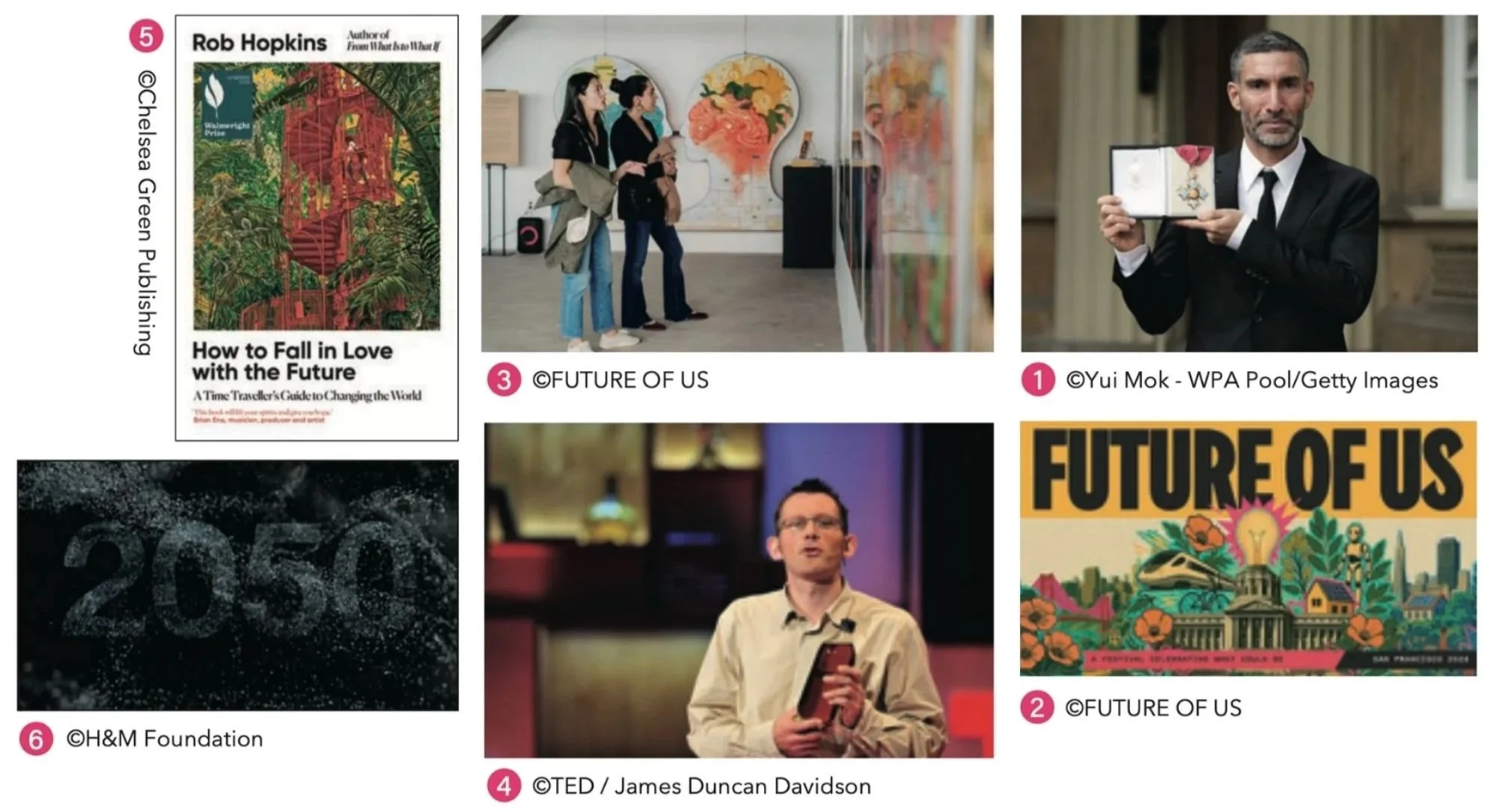
This year as the USA turned 250 years old, the city of San Francisco held the Future of Us festival with city government and cultural institution partners. The event celebrated more than 1,000 community-sourced visions after a year-long nationwide period of listening and speculative storytelling tour through guided dinners, local activations, digital prompts, and science center partnerships building a participatory template for what civic life could become. This is imagination as a genuine participatory mechanism rather than an internal workshop.
The Ministry of Imagination was built from the bonus episodes of Rob Hopkins’s podcast From What If to What Next. Hopkins is co-founder of Transition Network and "inaugurated" guests as Ministers, tasked to propose three bold policies in their field. Structured exactly like a shadow cabinet. The project is imagination applied to the highest-stakes arenas, government, health, justice, climate, using a structured method, organised into 35 portfolios from Democracy to Climate Change to City Planning.
Amongst many meaningful entries, Nancy Iraba’s seaweed farming policy forms the strongest Global South voice. As a Tanzanian Marine Scientist, cofounder of Healthy Seaweed Co. Limited and National Geographic Explorer, Iraba’s three ideas, seaweed financing framework, compulsory seaweed education in Tanzanian schools, the Gender Inclusive Seaweed Valuation Policy are concrete with specific market linkages, curriculum asks and gender-equity mechanisms, rather than the more abstract, aspirational register of some of the other entries. Seaweed farming sits at the intersection of food security, climate adaptation, and women's economic livelihood, three "unlikely arenas" at once, in a country that rarely gets cited. Iraba recently revealed she is collaborating with Action for Ocean, a youth-led Tanzanian non-profit dedicated to protecting marine ecosystems while strengthening the resilience of coastal communities.
In the fashion realm, the H&M Foundation's Reweaving Fashion & Textiles 2050 imagines a future fashion industry system fully decarbonised, told through audio testimony. Built with Planethon, a team of earth system scientists, business developers, and design thinkers translating climate science into liveable futures, the speculative initiative continues work the foundation began with Textiles in 2063, a story narrated from a generation not yet born.
Parting Thoughts
To change a system is to change a collective goal, and the rules underneath it. This requires imagining new norms and culture. Beyond the Rules is an initiative by Dark Matters Lab that explores how we can design new forms of governance for a life-ennobling economy and offers a public digital infrastructure of resources, with a particular focus on “the deep, thoughtful and highly creative work required to rewrite, reinvent or reimagine rules, norms and laws that hold us in the current system.”
The question is, when imagination is the new rule and structure, what does that look like? This is probably the biggest challenge, especially when even the most institutionally backed projects still largely depend on sustained will to survive past the initial gesture. “Strategic imagination” is having its much-needed moment. Whether it outlives the moment depends on whether it becomes something built into how we educate, perhaps even from childhood, on imagining futures as a necessity, the same way we teach literacy or arithmetic, rather than something we keep having to remind adults to do.
By Geraldine Wharry