Taste: the last intimacy
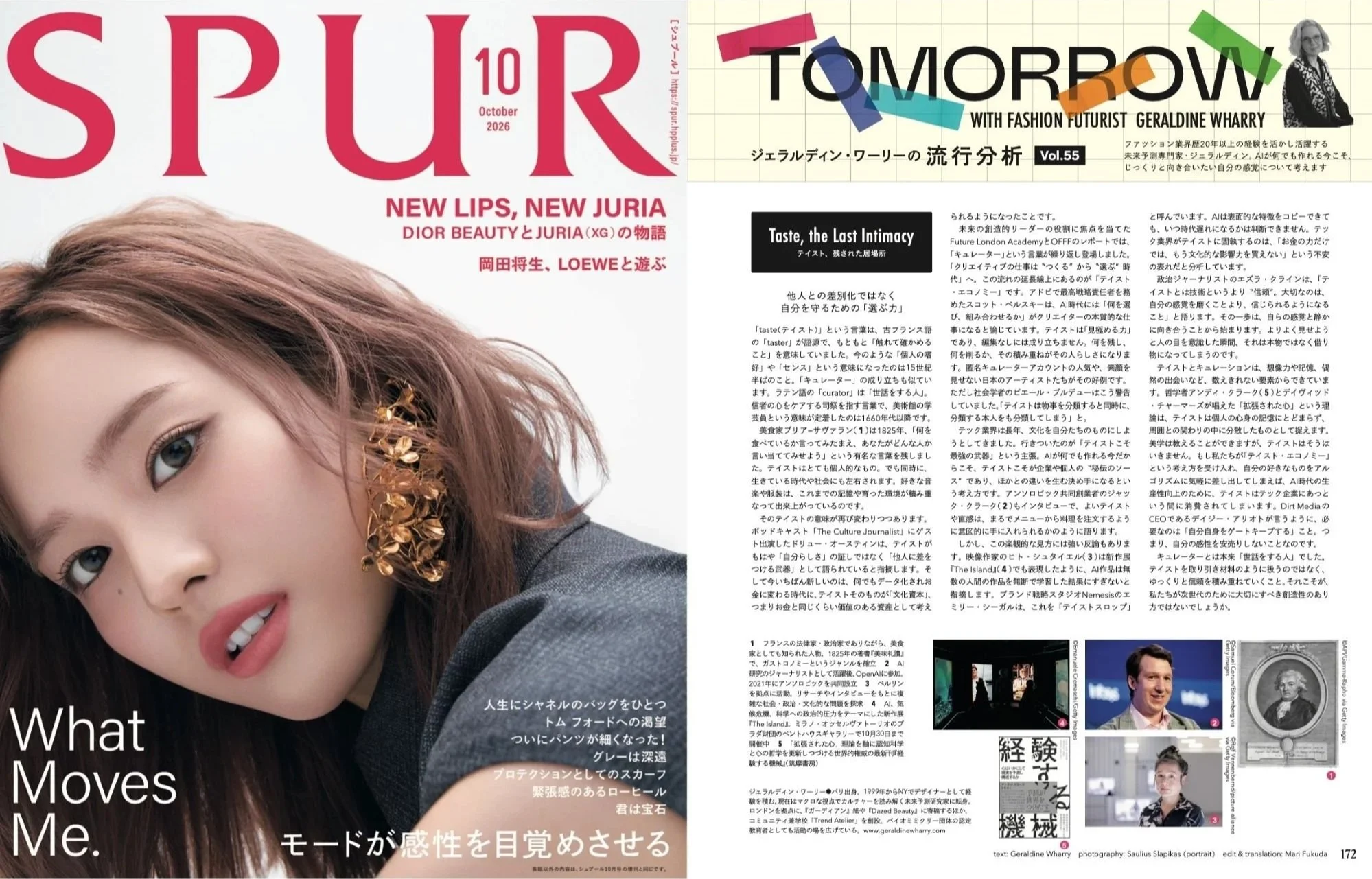
Image courtesy of Spur Magazine
The following article was originally published in SPUR magazine in my Tomorrow column.
The root of taste
Taste begins in the hand, not the eye. The word comes from Old French "taster": to feel, to touch, to sample by mouth, from Latin "taxare," to evaluate or handle. The aesthetic sense only appears in the mid-15th century. Curator has a similar history: Latin "curator," means one who has care of. A curate was originally a parish priest, responsible for the care of souls, not objects. The museum sense did not exist until the 1660s.
Why does this matter now? Taste began as touch and care. Today the conversation has shifted: taste is part of your productivity stack, a function to deploy like software. On The Culture Journalist podcast, Drew Austin argues the discourse now frames taste less as personal distinction, more as competitive edge. So, who decides? One could say fashion plays a big role in this. Tastemakers: editors, magazines, anyone fluent in trend. What is new is we now call taste "cultural capital" in an age of data and monetisation.
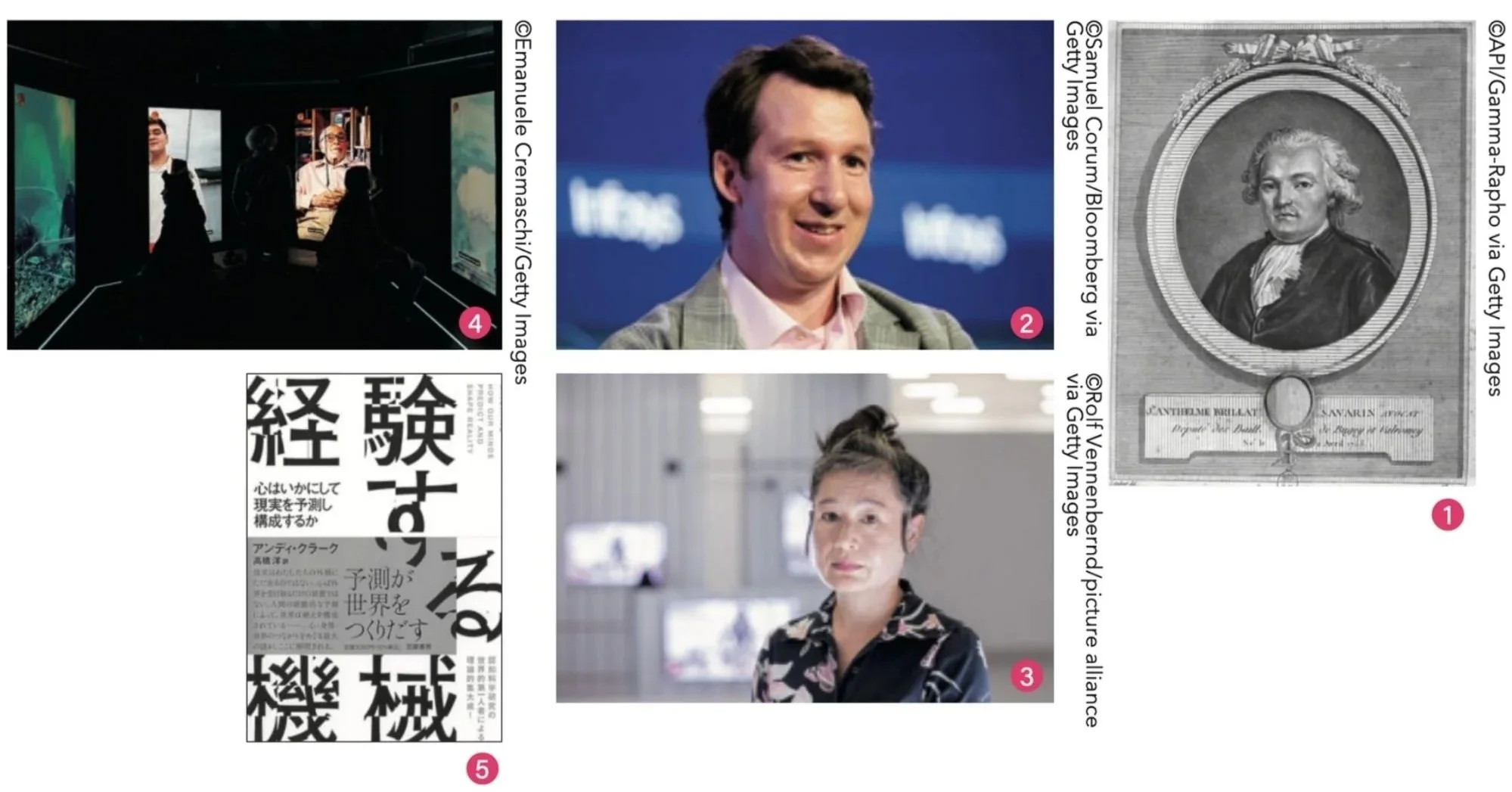
Jean Anthelme Brillat-Savarin, the French gastronome whose 1825 Physiologie du Goût is the founding text of taste-as-subject, said "Dis-moi ce que tu manges, je te dirai ce que tu es." Taste is personal yet accepted or rejected by a given culture and moment: the music you love, the way you communicate your identity, copy-pasted from feelings, memory, myth, personal cultural experience, and more, into something with emotional resonance.
ACT I: The pitch for being a chooser, not a maker
Asked how the creative leader's role will change, the Future London Academy × OFFF Future of Creativity report found one word came up repeatedly: curator. Not maker. "The language has moved from making things to choosing well." The creative as curator argument could likely be a cultural child of early Instagram days, where curating a feed was an artform of its own.
The "Taste Economy" is a close cousin to this thinking: the argument, from writers like Daisy Alioto and Scott Belsky, that in the age of AI, creatives will mainly become curators, taste the thing that makes anyone, or any brand, stand out. Matt Klein, Head of Foresight at Reddit and author of ZINE, is blunter, calling taste discourse mental gymnastics to feel superior to others: "aesthetics are the excuse."
Taste is about discernment, carefully choosing, and it cannot exist without curation. Curating is editing, and editing is the demonstration of taste, revealed in what is included and excluded, ego set aside. The artful edit precedes ego nowhere clearer than in social media's anonymous curator accounts, huge followings built on nothing but the edit itself. Even in mainstream pop, Japan has celebrated artists who resist facial exposure: "if the work is compelling, the worker can remain opaque," as Dave Ayodeji writes in How Japan Turned Anonymity into a Music Brand Advantage. Japan's "ninja-like" anonymous taste-YouTuber trend shows anonymity as an expression of taste, not a suppression of it
But Pierre Bourdieu warned taste is never neutral: "Taste classifies, and it classifies the classifier."
ACT II: How Silicon Valley’s excavation of creativity reflects its desperate attempts for what matters most: cultural capital
In wanting to own every corner of culture, Silicon Valley ended up beating the drum of taste as the moat. So much is now produced by AI that without taste to filter it, output alone loses meaning.
Anu Atluru's line from her essay Taste is Eating Silicon Valley grasps the moment: "In a world of scarcity, you want tools; in a world of abundance, you want taste." The pitch: we're now in the "curator era" with AI as the engine. As Jack Cheng puts it in What is Taste Really for Every: "Taste is the moat, the secret sauce, the difference-maker." Aporva Baxi argues machine output becomes infinite, discernment becomes the human layer: "the more AI can execute, the more your eye for what's interesting becomes everything." Jack Clark, co-founder of Anthropic, strikes the same note in his interview with Ezra Klein discussing good taste and intuition as if it were something you could control into existence, like ordering from a menu.
Filmmaker and artist Hito Steyerl offers the sharpest counterweight: her concept of the "derivative image", AI output built on large-scale, uncredited human labour, reframes AI-generated "taste" as parasitic, not a new human superpower. Lev Manovich complicates the "curator" identity itself: if AI image generation is itself a curation of a dataset of human-made material, "curator" may not be a new human role at all. Do we ultimately become data curators?
Nemesis's Emily Siegle calls out Tasteslop: AI is good at spotting the surface signs of taste and bad at knowing when they have gone stale. Tech's obsession with taste, she argues, is really a quiet anxiety over whether economic capital can still capture cultural capital, right as cultural capital becomes essential to Tech’s survival.
ACT III: Intimacy, not performance
Ezra Klein, on taste as trust rather than skill, asks: "Why does something spark for me and something else doesn't?" The real work was never developing the taste. It was learning to trust it, in private, not for display. The same goes for the trust of curators by their audience.
Creative taste starts with intimacy with your own lens, tended privately, not performed for an audience or an employer. That happens but shouldn't be the goal. The moment taste is performed for something; it stops being intimacy and becomes a costume.
Taste and curation emanate from creativity but are not its sum. Both are unquantifiable, made from imagination, intuition, childhood, upbringing, education, serendipity, conversations, mundane discoveries, scenes, smells, colours, memories, films and a thousand unaccounted inputs forming the gaze we use to curate. The "extended mind" theory, from Andy Clark and David Chalmers, frames taste as distributed rather than solitary, never a personal asset. Aesthetics can be taught, emulated, mimicked. Taste cannot, unless we accept it belongs to the AI productivity era.
Buy into the taste economy, that taste is a commodity, a data point in itself, and we give our taste away to technologists. Daisy Alioto warns in her taste economy lecture: "Start gatekeeping yourself."
Parting thoughts
Silicon Valley and AI leaders are telling creatives: don't worry about being replaced, you'll be promoted into the role of curator, taste-haver. That's the pitch, and it's a lie, or at least a sales point dressed as a forecast. Creativity has always involved curation and taste, that isn't new and isn't the lie. What's dishonest is repackaging one part of creative labour as the whole remaining job, at the exact moment the rest of it is being devalued.
Curator, the carer. This is where I want to land: a slower, more intentional creativity, one that guides and earns trust, rather than flipping taste and curation like points to claim. I want to stay intimate, exclude scale.
Taste is about relevance, yes, even hierarchy, a differentiator. But how we get there isn't about markets and competition. That's boring, and manipulative. It boils down to the magic of how creativity even exists. Everyone wants to put a formula on it, control it. Let it be. Our job is to protect it, for generations to come, from being rewritten.
By Geraldine Wharry