The Anatomy of Creativity
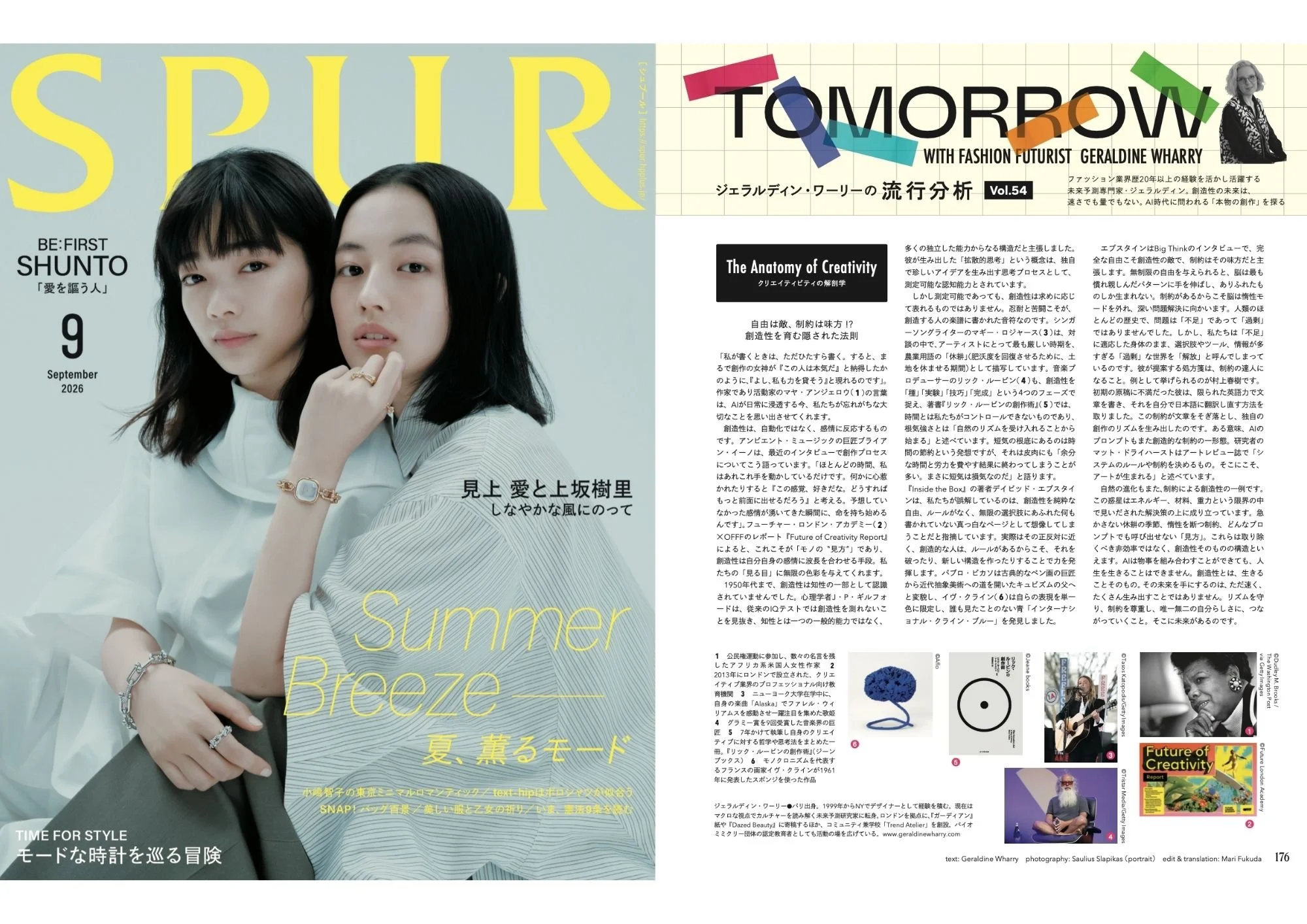
Image courtesy of Spur Magazine
The following article was originally published in SPUR magazine in my Tomorrow column.
Intro: Where does creativity come from
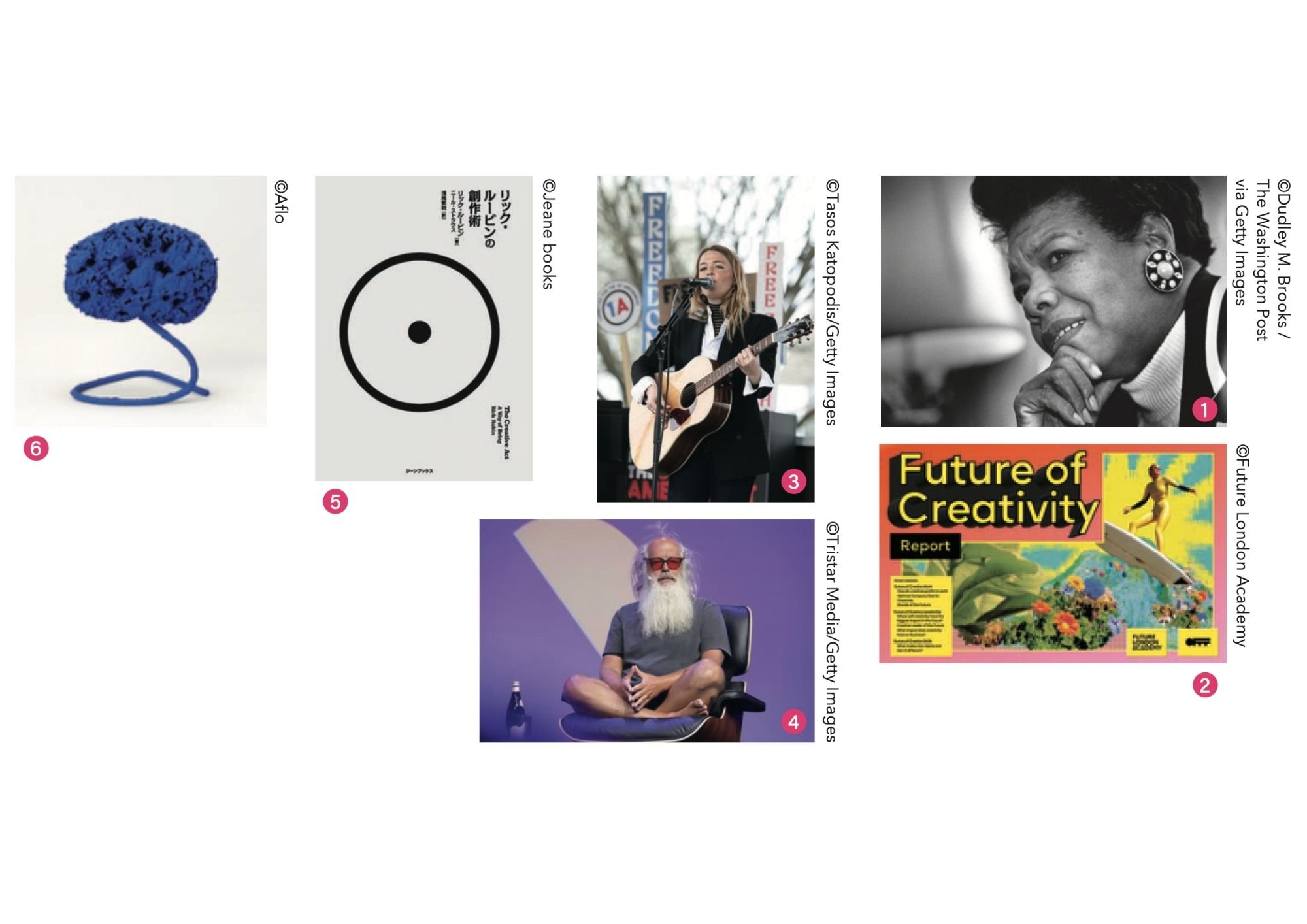
"When I am writing, I write. And then it's as if the muse is convinced I am serious and says, 'Ok, I'll come.’.” Writer and Activist Maya Angelou understood something we tend to forget as AI penetrates all areas of our lives. Creativity answers to ritual and feelings, not to pressure and automation. Brian Eno, credited for pioneering generative music, described his creative process to Ezra Klein in a recent conversation: “Most of the time, I’m fiddling around […] Something intrigues me, or some feeling starts to happen, and I think: I like that feeling. How can I bring that forward? How can I make more of it? […] When you are making something, it starts to come alive when you start to have feelings that you didn’t expect from it.” Creativity helps us tune into our emotions and gives our gaze an infinity of colours. “It’s a way of seeing”, a quote that stuck with me when reading The Future London Academy × OFFF report ‘The Future of Creativity’.
ACT I: How does creativity thrive? Not on demand.
Until the 1950s, we didn’t recognise creativity as part of the intellect. American psychologist J.P. Guilford recognized that traditional IQ tests were not useful for measuring creativity and argued that intellect is a structured system of many independent abilities, not one general capacity. He birthed the idea that divergent thinking is a key measurable cognitive ability, a creative thought process that often produces unique or unusual ideas.
But even when measurable, creativity doesn’t appear on demand. Patience and struggle are the notes to the creative’s music sheet. Singer songwriter Maggie Rogers in her conversation with Willem Defebaugh on How to protect and nurture your creativity uses nature as a metaphor, describing the hardest test of an artist's identity as the ‘fallow’ period of ‘nothingness’. In agriculture, fallow describes the period land is left alone without sowing, in order to restore its fertility. Rick Rubin, who has spent a career producing leading musical artists, similarly sees creativity not as a single sustained push but as a sequence of seasons: a seed, experimentation, craft, completion. The theme of human rhythm expands with the outcome of Imaginative Intelligences sessions hosted by Mozilla and the Berggruen Institute, where creativity was referred to as “Embodied, Limited, Relational and deeply tied to Purpose, Struggle, Meaning making.” In ‘The Future of Creativity’ report, DINES, Co-Founder & Creative Director of STUDIO BLUP shares "I try not to force creativity. The best concepts usually come when curiosity, culture, and instinct are allowed space to connect without pressure."
Why is time such a critical element? In his seminal book The Creative Act, Rick Rubin describes time as “something that we have no control over. So, patience begins with acceptance of natural rhythms. The implied benefit of impatience is to save time by speeding up and skipping ahead of those rhythms. Paradoxically, this ends up taking more time and using more energy. It’s wasted effort.” I have come to call this Radical Efficiency Rationalism: the mirage of immediate solutions. Rubin separates the Experimenter, who loves to dream and struggles to finish, from the Finisher, who races to the end and skips the play, but notes that each needs the other's season.
ACT II: Constraints are not the enemy of creativity. They are its engine.
“The history of innovation is one narrowly defined problem after another” according to David Epstein, author of Inside the Box: How Constraints Make Us Better. This sums up the dichotomy of creativity. It can’t be automated, contained. Yet, it thrives with constraints. What we get wrong: we picture creativity as pure freedom, a blank page, no rules, infinite options. It is closer to the opposite: creative thinkers thrive with structure, breaking them or creating new ones. Pablo Picasso went from being a master of classical pen drawings to fathering Cubism, which opened the door to modern abstract art. Yves Klein limited himself to a single colour and discovered a blue no one had seen before, later named after him.
Epstein, in his interview with Big Think Discipline sets creativity free, makes the case that total freedom is the enemy of creativity, and constraint is its companion. The reason is mechanical. Left to unlimited freedom, the brain reaches for its most familiar patterns and produces the unoriginal; constraints push it off autopilot and into deeper problem-solving. He frames this with the long lens: for almost all of human history our problem was scarcity, not surfeit. We are wired for too little and have built a world of too much: too much choice, too many tools, solutions, too much information, too many open tabs, and called it liberation. His remedy is a "subtraction audit" and becoming expert limiters. He cites the example of Haruki Murakami. Frustrated by his own early pages, he began writing in his limited English and translating himself back into Japanese. The constraint pared his prose down to generate "a creative rhythm distinctively my own." In some ways AI prompts also set creative constraints that appeal to a growing body of artists and designers. Artist, musician, and technological researcher Mat Dryhurst shared with Art Review in What Is Post-AI Art? "The agent that sets the rules or constraints of a system: that's where the art happens."
Natural evolution is also creativity under constraint: every elegant form on earth is a solution worked out against the hard limits of energy, material and gravity. Constraints are what this planet is built on. I would add that constraints, or rules, teach us to break them. We choose not to follow something or someone because it’s popular or what we were taught. We choose our own path. Creativity’s biggest constraint: connect with your uniqueness, unashamedly.
PARTING THOUGHTS: Creativity fuels resilience
Our cultural, technological and economic perception of efficiency and productivity is at war with cultivating creativity. Automation vs ritual, impatience vs natural rhythm, infinite freedom vs constraint. These are the tensions to contend with as we forge ahead in our complex world. The fallow season that can't be rushed, the constraint that pushes us off autopilot, the way of seeing that no prompt can summon. They are not inefficiencies to optimise away. They are the anatomy of creativity itself. AI can recombine, but it cannot live a life. Creativity is life and its future won't belong to whoever produces the most, the fastest. It will belong to those who protect the rhythm, honour the constraint, and connect with their uniqueness, unashamedly.
By Geraldine Wharry