Stop Inventing Start Returning - When Trends become Circular

Image courtesy of Spur Magazine
The following article was originally published in SPUR magazine in my Tomorrow column.
Fashion trends tend to repeat in a 20-year cycle. That is their nature, coined the “20-year-rule’ by industry insiders. A new study by researchers at Northwestern University now backs this anecdotal claim with mathematics. Using the most comprehensive fashion database to date made of 37,000 images of women’s clothing spanning from 1869 to today – researchers created a new mathematical model that proves trends repeat approximately every 20 years. These findings could also help explain how new ideas spread in society. Study co-author Dr. Daniel Abrams states “Over time, this constant push to be different from the recent past causes styles to swing back and forth. The system intrinsically wants to oscillate, and we see those cycles in the data.”
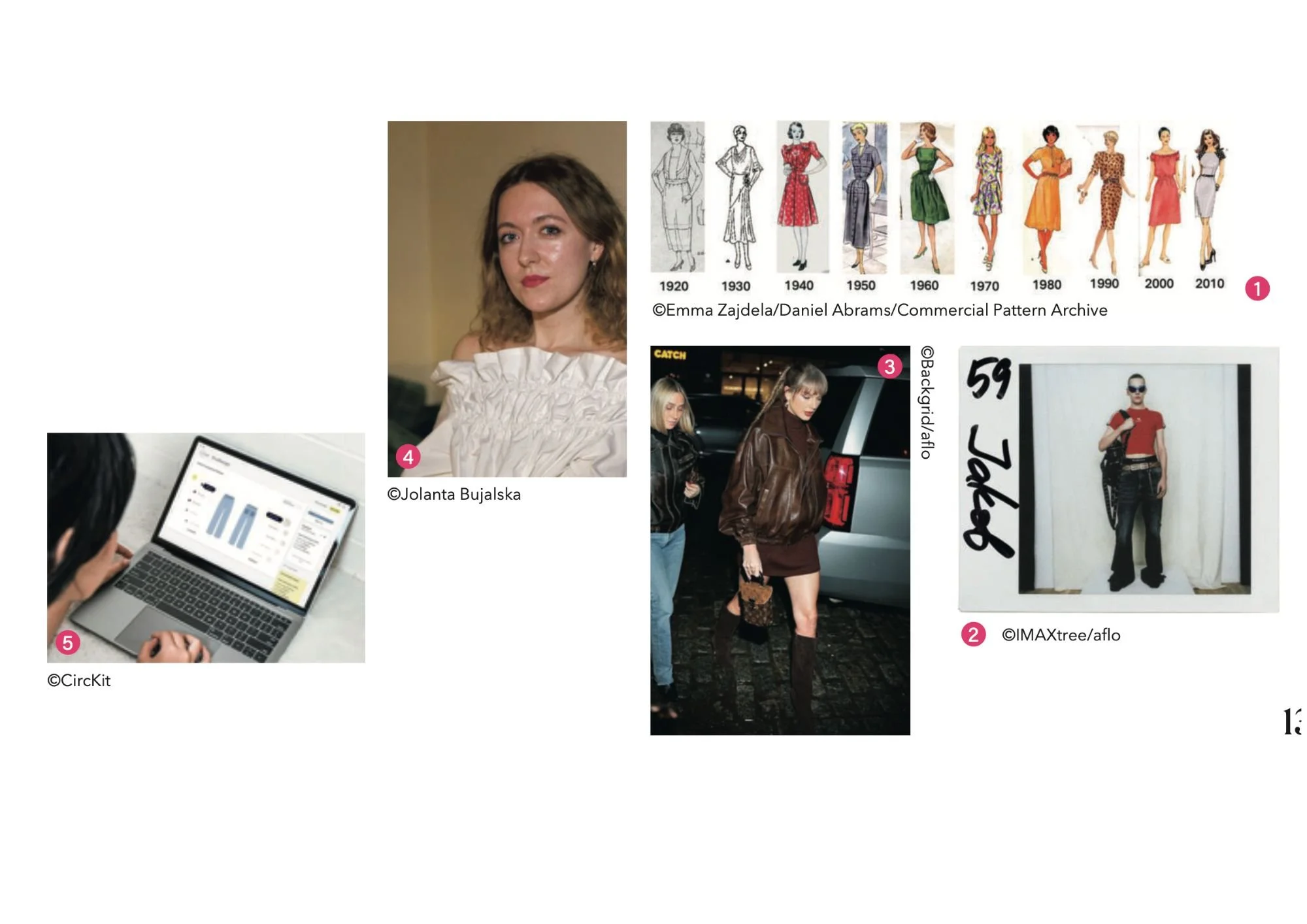
There’s beauty to the cyclical nature of fashion as it creates a circular space for recomposing our shared memories. An infinite well of creativity and diversity opens up when we experience fashion as a story we can relive and rewrite, versus consume and throw. Carbon copy revivals of 90s fashion by Balenciaga or Taylor Swift bringing back her braided millennial hairstyle carried us because of their resonance that was much more than aesthetic. Fashion, art, culture, design writer and art historian Sophie Axon in her essay Fashion keeps repeating itself, and we keep forgetting, sums our relationship with fashion timescales “We do not simply dress for the present moment; we dress through it. Sometimes those memories surface vividly. Not as abstractions, but as visual rhymes: a hemline echoing another century, a pair of earrings that bridge generations. These moments are not accidental. They are emotional flashpoints.”
However, in the past decade, and more noticeably during and after the pandemic, we became obsessed with hollow microtrends disguising as new, when they were nostalgic reboots spread online by Monday, dead by Friday, fuelling fast fashion consumption. I coined this the Hypercycle in 2021: a relentless, accelerating churn of trends that creates overwhelming amounts of noise and waste in equal measure. Somewhere in the chaos and what I view as a collective act of self-betrayal, fashion lost the plot entirely: exhausting designers, overwhelming consumers, diluting what personal style means, all whilst devastating the planet.
But fashion history is built on counter reactions. Sustainable fashion journalist, content creator and campaigner Katie Robinson explains in Did 2025 kill the trend cycle? how the incessant trend cycle has created a backlash, a loss of trust in the entire fashion industry, fuelled by micro trend and influencer fatigue that has left consumers and fashion lovers feeling empty. She describes this as a societal shift reflecting the growing weariness of social media content, influencers and TikTok fashion culture, stating ‘reach without resonance is a dead end’. Out of touch micro trends are now a ‘low status behaviour’ according to Robinson, whilst Michael Appler, communications director at analytics firm Trendalytics, describes them as “meme-like abstractions”.
Social anxieties have always been reflected in Fashion which acts as a mirror of our times and current global risks indicators are sky high, as outlined in the World Economic Forum’s recent Global Risks Report 2026. The world feels unstable, the job market is shrinking and the cost-of-living is skyrocketing. YouTuber Social Symone in Are Luxury Influencers Out of Touch… Or Is Everybody Just Broke? describes how fashion influencer content has become economically and psychologically unsustainable for consumers, especially content focused on Haul Culture and luxury lifestyle.
Instead, there is a return to the ‘mother nature’ of why we dress: developing personal style. Beth Bentley, Founder of Tomorrowism and author of the popular Substack Pattern Recognition, lists in Is the trend cycle finally slowing down? the 4 backlash reasons consumers are focusing on going back to fashion’s essence:
“PERMANENCE in the motion-sickness whiplash merry-go-round.
AUTONOMY when so much feels out of our control.
INDIVIDUALITY vs algorithmic groupthink.
CLARITY in the confusing melee of too-much-choice.”
What makes fashion matter? It has always been expressing the self through style, a combined embodiment of history, modernity and self-expression. We write our own unique reality, displaying our evolving inner nature to others through clothing. But our fashion reconfigurations are more than individualistic, they are a reflection of humanity's collective memory and expression. This questions the seat of personal style from the vantage point of the collective human project seeking connection, rather than an isolated atom seeking personal fame.
Trends, personal style, fashion, all behave exactly like natural systems. They are interdependent, they rise, recede and return. Aesthetics, moods or ‘vibes’, as we frame them today, surface in new contexts but are rooted in what came before. Trends are circular ecosystems with their own natural truth steeped in shared memory because fashion has always been in conversation with its own past.
If a natural flow of circularity is the truth behind fashion trends, then the fashion industry has one urgent question to answer: why are we still making collections following new trends that are just repetitions of the past? 1.6 billion items of clothing sit unused in UK wardrobes alone, a new analysis from Oxfam reveals. Enough to dress Manchester for 450 years. By 2050, the fashion industry is on course to produce 138 billion items of unworn clothes every year, enough to almost reach from the Earth to Mars and back. And at a time when the cost of living makes getting dressed feel like a moral and financial obstacle course, a circular approach to trends is not just good for the planet, it is good for people. Today the fashion industry could stop manufacturing new versions of things that already exist. We have the technology to create a fashion system that is intelligently working with the cyclical nature of fashion trends. With companies pioneering new design systems such as CircKit powered by AI, we could combine responsible design and trend forecasting, unsold and vintage stock tracking with circular economy principles.
Parting Thoughts
Does newness even matter? The essence and nature of fashion was never about new trends. As Willow Defebaugh, cofounder and editor-in-chief of Atmos, writes in Life Imitates Life In the Evolutionary Marvel of Mimicry: "If all our atoms are borrowed, can any of us truly be original? Nature is a panoply of mirrors, life imitating itself through iteration and imitation: especially through the evolutionary marvel that is mimicry." The most radical thing we can ask is not what is new, but what is worth returning to, and how do we make it better this time?
By Geraldine Wharry