Are Fashion Trends Already Circular? A New Model for Regenerative Forecasting

Yes — fashion trends have always been circular. They move in ecosystems, return in cycles, and repeat the same colours, silhouettes and themes season after season. The inconvenient truth the industry refuses to act on is this: we are not inventing new trends. We are recycling them — while manufacturing as if we aren't. Reframing trend forecasting as a circular resource, rather than an engine of novelty, could be one of the most powerful and underused levers in fashion's sustainability toolkit.
Design is not about Products. Design is about relationships. [...] By addressing the after life of every product, designers contribute to a change in mentality in both users and producers. An all encompassing approach requires designers not to focus exclusively on the functional and expressive quality of a design, but to also investigate how maintenance and repair can be integrated in the final product. Designers should be aware of the circular economy they are embedded in. - Hella Jongerius “Beyond the New”
As a regenerative futures architect and former fashion designer, I see the responsibility we hold in informing our clients. Season after season. Collection after collection. With more and more raw materials, resources extracted from our one and only planet. I have chosen to focus on relationships that demand regeneration. The circular economy and the regenerative model are not the same thing — but they start in the same place: the honest admission that what we take, we must return.
Some powerful innovations are emerging from materials designers and fashion businesses embedding circular principles — but trend agencies themselves, the very organisations that shape what gets made, have been slow to change their own business models accordingly. That needs to change.
Embedding circular design systems into fashion trend forecasting would require one thing the industry has never built: an intelligent shared library.
I see a future of trend insights where we can point out when for example the same colour is being used from a past season, linking it back to a manufacturer who would still have that colour in stock. Imagine a forecaster flagging: this coral was on trend in SS22 and there are 40,000 metres still in a warehouse in Como. Intelligent materials and trend libraries connected with live feeds of suppliers' stocks. For this AI and software development would come into play.
This would avoid unnecessary re-manufacturing and would require buy-in from manufacturers who must also explore new economic models and technologies to eliminate order minimums. The vicious cycle of over-ordering due to high minimums, and at the far end of that, unsold stocks ending up in landfills or fire-pits must be a thing of the past. And for this we must think creatively and engineer new economic models.
The reason this library doesn't exist yet is structural. Our entire fashion system — from fibre to landfill — is still built on Take, Make, Waste. Although this is gradually changing, it is unfortunately not fast enough.
The linear path to producing a fashion collection relies heavily on trend forecasting
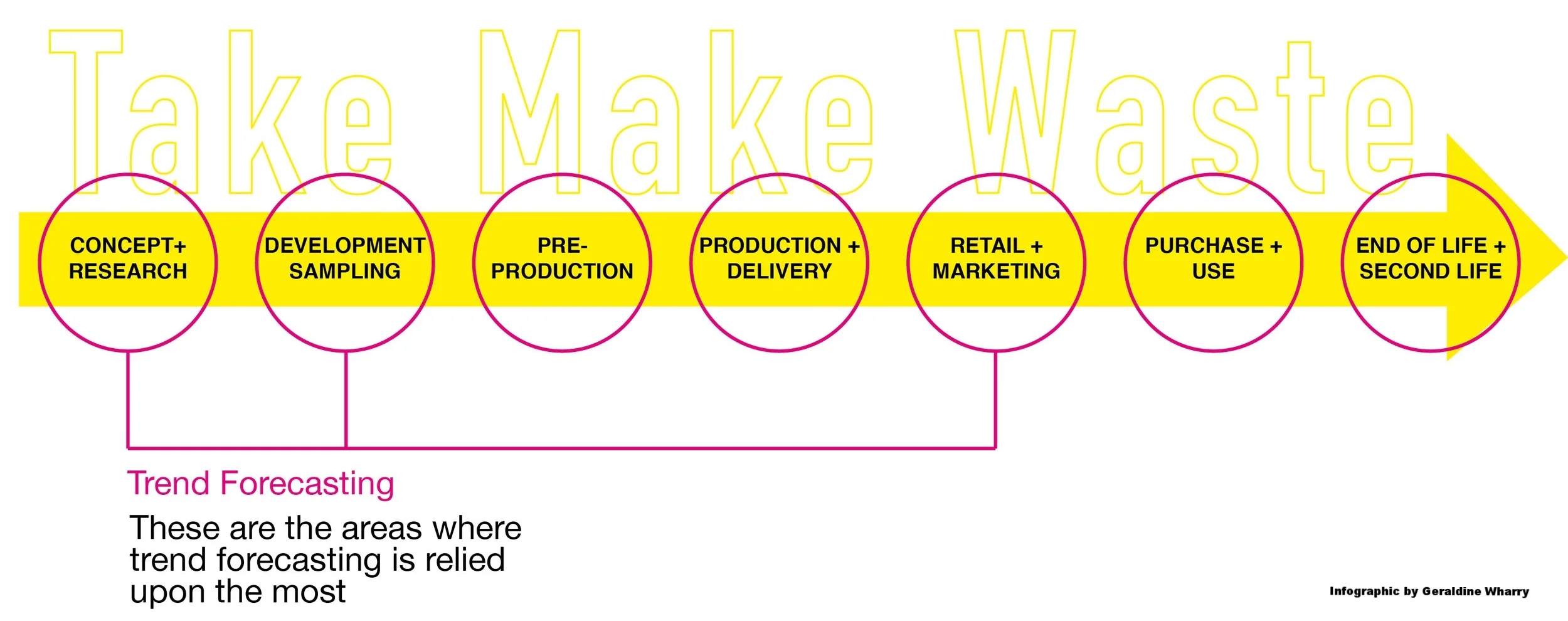
Because the style industries depend on trend forecasting — at every stage of the critical path from concept to collection — there is a massive opportunity to connect resources and break the repetitive cycle of manufacturing the same trends as if they were new. Circular Economy Organisations like the Ellen MacArthur Foundation have shown what systemic change looks like. Now trend forecasting needs its own version of that circular framework.
We must urgently change the culture of how we source, design and perceive what is hot and on trend. And to have real impact this must be done at scale, reformatting the fashion trend forecasting and designing system at three levels.
First, how we select and develop collection concepts — examining which themes we have previously used so we can build upon existing ideas and stocks rather than fabricating novelty. Second, how we source at trade shows, making in-stock materials and recurring trends a highlight for re-use rather than a footnote. Third, and perhaps most radically, how we retail and tell brand stories — moving beyond seasons entirely toward a continuous, evolving narrative that doesn't require a new collection to have something to say.
What the industry needs now are not just designers and creative thinkers — though we need those too. What we urgently need are system changers. System creators. Fashion Engineers who will fundamentally rethink the way resources are connected, cycled and reused to achieve zero impact on the planet.
These new roles will sit at the convergence of technology, science, design, marketing and product lifecycle management. And trend agencies and forecasters should act as a key resource within that ecosystem — organisations that have spent years analysing trends, tradeshow reports, street style and consumer insights, and can identify precisely when re-use is needed due to the repetition of concepts and materials.
A trend would be, as always, valued on its creativity. But it should also be evaluated on how it enables recycling. That would offer a completely new way of harnessing fashion trends — not as ideas that live in thin air, but as levers that lead to global shifts in manufacturing and raw material extraction. This is why they are central to our sustainability goals, not peripheral to them.
The time is now for an honest conversation.
Fashion trends are moving slower than ever, and we see the same themes rehashed season after season. Shouldn't that be a powerful fast track to reusing fabrics, trims and colours? If brocades and pink are on trend for several seasons, why do we keep manufacturing new versions? Can we afford this luxury? I think not.
Of course there is a need to create, to explore what comes next. Curiosity is a fundamental part of being human. But we have radical choices to make. Fashion is one of the world's most polluting industries — and trend forecasting sits right at the start of that pipeline. The responsibility is ours.
We need to drastically rethink how we utilise trends — and recognising their natural circularity is where that rethinking begins.

Trends are not linear inventions. They are collaborative and cyclical by nature. From macro cultural shifts to seasonal micro-trends, they form an ecosystem of molecules — each one reflecting a key tension, desire or conversation shaping how we engage with the world through dress. They rise, they recede, they return. Just like nature.
Nature doesn't just close the loop. It regenerates. Every cycle leaves the system more alive than before. That is the difference between circular and regenerative — and it is the standard fashion should be reaching for.
These are not nature metaphors. It is a structural truth. Nature has been running a circular, restorative, regenerative system for 3.8 billion years — designing with end-of-life recovery built in, wasting nothing, reusing everything. The circular economy is simply our attempt to catch up with what nature already knows. And trends, at their core, already behave the same way. We just haven't built our systems to reflect that.
If we embed a proactive circular design approach — where materials, colours and concepts are tracked, reused and reconnected across seasons — we would not be fighting against the nature of trends. We would finally be working with it. Trend resources could become one of the central pillars of a regenerative fashion system. That is not just an opportunity. It is an ethical responsibility.
In the circular world, design is never done. Products and services are continuously redefined to push waste out and minimise negative impact at every stage.

The circular mindset involves everyone who extracts, builds, uses and eventually disposes — and the role of the designer, the forecaster and the emerging Fashion Engineer can enter the cycle at any point within it.
This is the particular beauty of circular design. It requires opposing ends of the fashion spectrum to collaborate — the trend forecaster and the textile recycler, the creative director and the supply chain engineer — examining the full life cycle of a product and solving the specific material and design challenges they each face. It is by nature innovative, interdisciplinary and generative.
And trend forecasting belongs at the centre of that collaboration — not at the beginning of a linear pipeline, but woven throughout a circular one.
We have long used trend forecasting to follow commercial reality. But that has always been a reduction of what it truly is. At its core, trend forecasting is not about following the future. It is about creating it. In a regenerative fashion system, that creative power could finally be directed where it is most needed — not toward manufacturing novelty, but toward building something that lasts.
The climate crisis is the greatest innovation opportunity of our generation. The question is not whether fashion must change — it is who will have the courage to redesign it. This is our moment to build new perspectives on the 'new': a future where circular is the only direction worth moving in.

Let us not be discouraged by the scale of what needs to change. Let us not continue in the kind complacency of trying — thinking about it, talking about it, while the system remains unchanged.
We must walk the walk. The window to prevent catastrophic temperature rises is not a distant deadline — it is measured in years, not decades. The UN has made this unequivocally clear. And the cost of inaction — hunger, environmental collapse, poverty, conflict — dwarfs any financial or political risk that systemic change might demand of us.
If the future involves our species not only surviving but thriving, we need to create regenerative fashion systems that both uproot our destructive current ways with the determination to challenge embedded financial and political interests, and protect what we already have by building contingency structures while we construct something better and permanent.
Years ago I had a dream — probably set in New York, where I was living at the time — of a skyscraper city fully submerged underwater. People worked in offices that had existed long before the waters rose. The foundations had been reinforced. Business as usual, beneath the surface. I have never forgotten it. Because the question it posed is one we are now living: if we cannot change the fashion system fast enough, what is our survival plan?
The answer, I believe, starts here. With trends. With forecasting. With the industry that shapes what the world makes next, finally deciding to make it circular.
| By Geraldine Wharry
This piece was published in 2018. Elements of this have been edited in 2026.
The work, ideas and schematics are protected under International Copyright law - All Rights Reserved © 2018-2026 Geraldine Wharry. Any unauthorised broadcasting, public performance, copying or re-recording of this article and the ideas, schematics hereby outlined will constitute an infringement of copyright. No part of this publication may be reproduced, distributed, or transmitted in any form or by any means, including photocopying, recording, or other electronic or mechanical methods, without the prior written permission of the publisher. For further inquiries please contact hello@geraldinewharry.com