Wired for Wonder
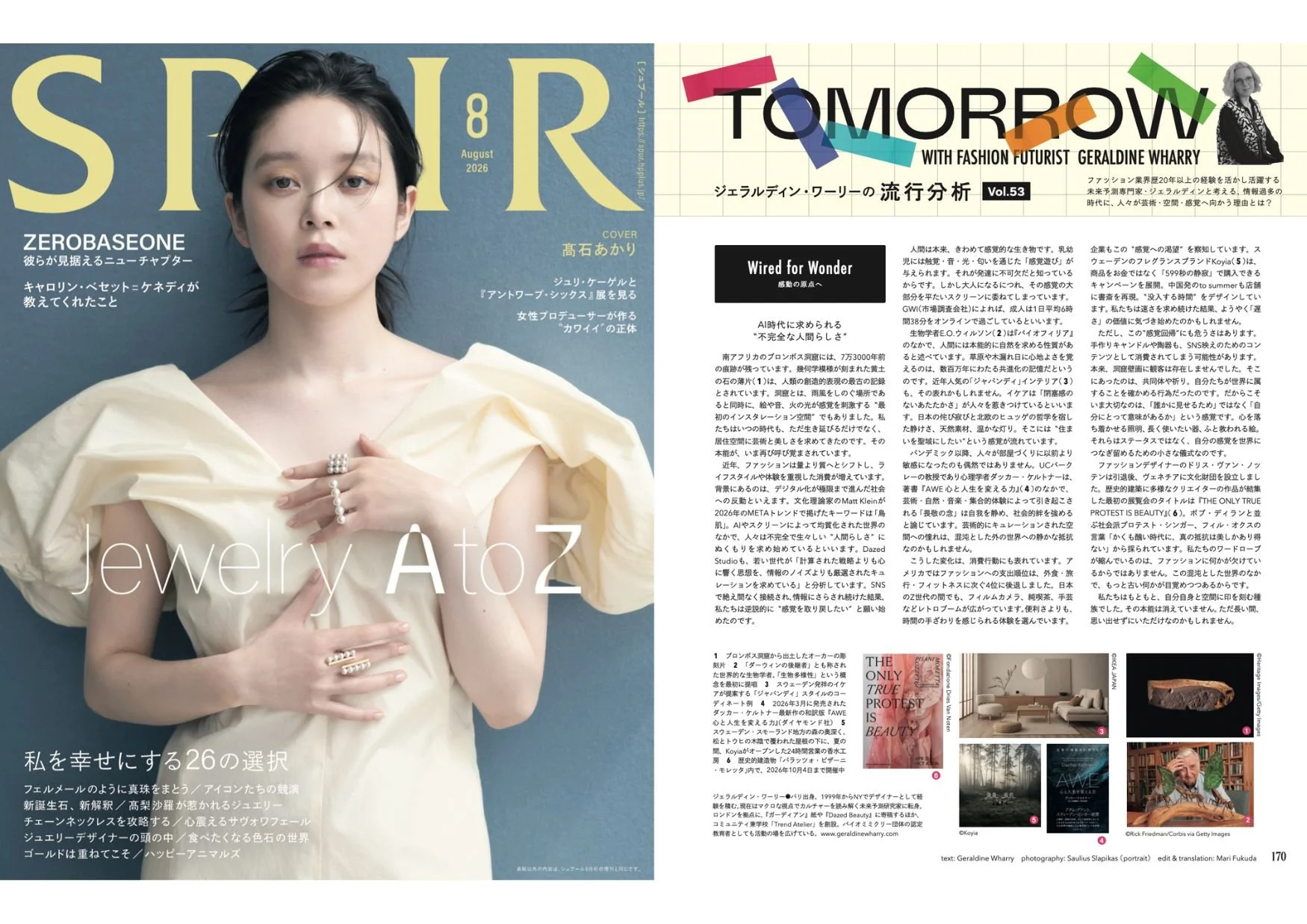
Image courtesy of Spur Magazine
The following article was originally published in SPUR magazine in my Tomorrow column.
Before the Screen, There Was the Cave
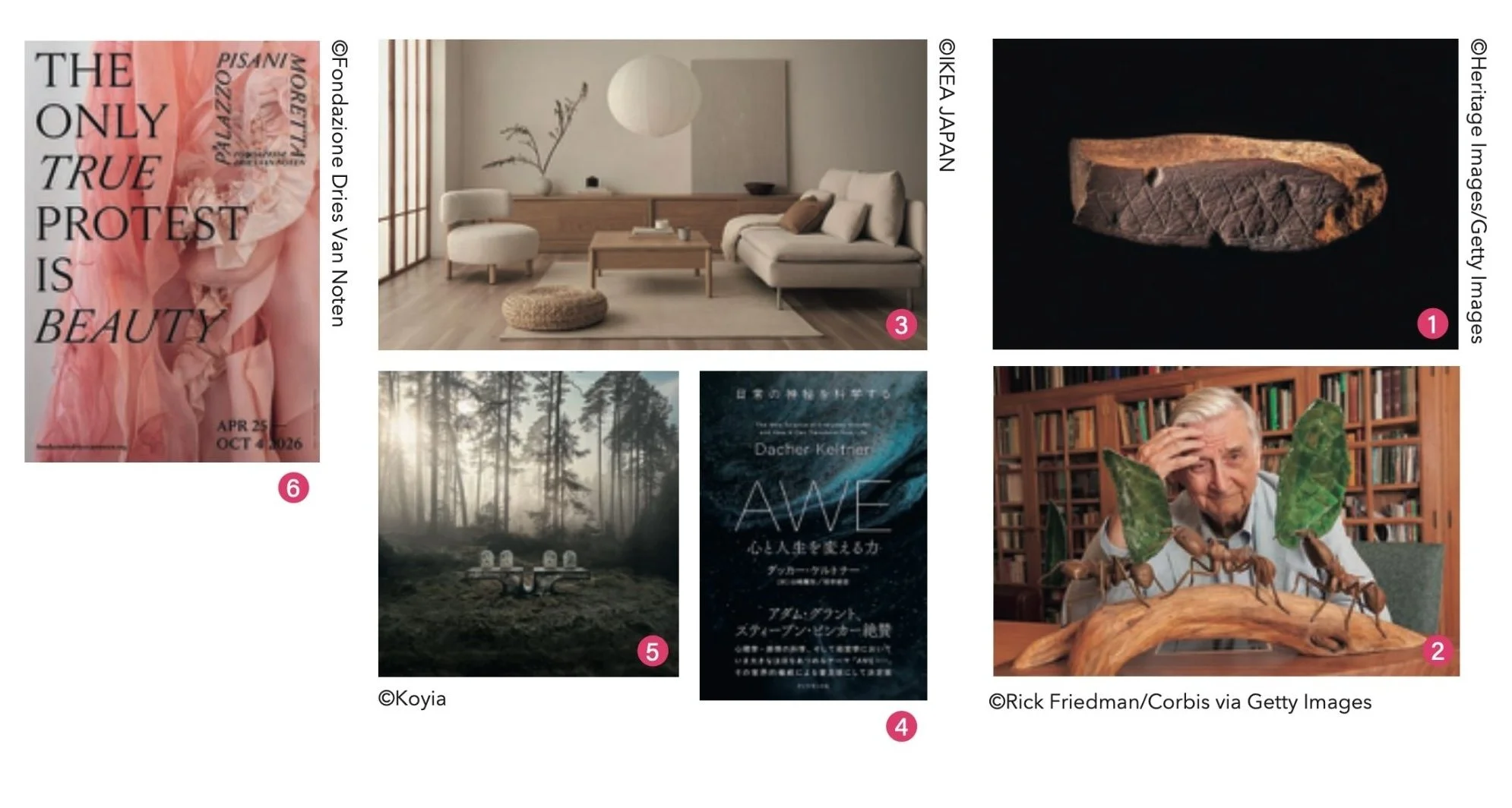
The first room we designed was the 73,000-year-old Blombos Cave in South Africa. Ochre blocks etched with geometric patterns, presumed decorative stamps, are the earliest record of human creative expression. The desire for sensory experiences, for art and beauty in inhabited spaces was never a contemporary premium or growing trend. It is one of the oldest primal things about us.
The recent pivot to lifestyle purchases and wardrobes shrinking is because we're remembering what we're made of. The need to make spaces and experiences of wonder is one of the most persistent expressions of human intelligence, and the earliest form of collective meaning-making. Palaeolithic cave art itself was a multi-sensory installation, where visual and acoustic experience merged into an immersive environment. The cave wasn't passive shelter; it was our first meaningfully designed interior.
Where is meaning making today? In Matt Klein's 2026 META Trends, the first trend is 'Goosebumps': 'unflattened, imperfect human characteristics warm us amidst frigid glass screens, AI, and division.' A counter to what's known as ‘Meta-stress’, a loop of stress about being stressed by our hyperconnected environment. According to Dazed Studio’s report What’s inspiring our next wave of insight: human-made, mythic, and meaningful, ‘Youth are craving humanity over AI automation; symbolism over strategy; curation over noise.’ In a wired world, we seem to want to reboot our sensorial default mode.
ACT I: The Sensory Animal
We invest enormous care and money in sensory play for newborn babies. Sensory stimulation is vital to promoting normal development and helps children learn about the world, communicate, and form attachments to other people. Yet in our modern era, we have decided to outsource our senses to flat screens. GWI’s latest research finds that adult internet users now spend an average of 6 hours and 38 minutes online each day.
E.O. Wilson’s foundational book Biophilia argues that our need to shape and inhabit beautiful spaces is not lifestyle aspiration, it’s biology. A deep affiliation with the living world, rooted in genetics, shaped by millions of years of co-evolution. We instinctively attempt to recreate vanished savannah habitats in our cities. The landscapes that please us tend to feature open grassland, clumps of sheltering trees, and running water. Frontiers in Psychology’s peer-reviewed paper Biophilia as Evolutionary Adaptation confirms that biophilia is present since early childhood, has its counterpart in animals, determined by innate biological mechanisms.
When we apply this to interiors, the desire for natural materials, calm spaces, warm light is not 'trending', it's encoded. This could explain why Japandi style interiors feel exhaling. The combination of Japanese and Scandinavian aesthetics where homes became sanctuaries informed by wabi-sabi and hygge philosophies, is rooted in the post-pandemic lifestyle shift toward more intentional living.
Across cultures and throughout history, inspiring awe is what humans have turned to when the world feels ungovernable. In Awe: The New Science of Everyday Wonder, Professor of Psychology at UC Berkeley Dacher Keltner weaves the argument that awe, triggered by art, nature, music and collective experience, quiets the self and strengthens social bonds. The cave wall was perhaps a response to the chaos outside it, as is today’s growing interest in artfully curated interiors.
ACT II: The Expanded Life
The data confirms what our senses have been craving. Fashion spending has dropped to fourth place in US consumer discretionary priorities, behind dining out, travel and fitness, according to a recent survey by Fashion by Informa. This supports the ‘sister’ trend for ‘Underconsumption core‘. Japan’s Gen Z is engaging in what analysts are calling ‘retro resistance‘: a deliberate pushback against digital speed expressed through film cameras, vinyl, vintage cafés, craft and reading clubs.
We've always been sensory creatures. We've just built a world that starves that need, and the youngest generation raised entirely on screens is feeling the hunger most acutely. That commerce is reading this hunger shows how structural the shift has become. The Swedish fragrance brand Koyia offers customers the choice to ‘pay’ with 599 seconds of stillness instead of 599 kronor, and fragrance brand ToSummer integrates reading culture into its retail spaces, designing for a state of flow.
The appetite for slowing down signals a return to being our instinctive selves again, it’s that simple. Marie Dollé, author of Selfpressionisme and cultural analyst explains ‘our survival will not depend on our ability to become faster processors, but on our boldness in cultivating a more sensitive presence […] True protection against obsolescence lies there: in a form of sensory sovereignty, an agility rooted in instinct, a capacity to read the invisible and to sense, in the body, what is at stake.’
PARTING THOUGHTS: The Oldest Instinct
In the cave, there was no audience. The painting was for the dwellers, for the gods, for the dead, for the animals, not for fame. Reclaiming that raw honesty is the real act of resistance against how much our modern lives weigh us down. A risk is that the trend for ‘sensory experiences’ becomes the next status format. The handmade candle photographed for Instagram. The artisan ceramics as flex. The sensory experience as content. Every genuine human impulse seems to eventually get colonised by the attention economy. But the more uplifting question is what belongs to you, privately, irreducibly? Art, design, food, ritual only do the work when they are chosen for the private accumulation of meaning-making, not public performance.
After retiring from his eponymous label, Dries Van Noten opened a cultural foundation inside Venice’s Palazzo Pisani Moretta, with an inaugural exhibition gathering artefacts from fashion, jewellery, design, art, photography, glass, ceramics, and material experimentation. The exhibit’s title The Only True Protest Is Beauty draws from Phil Ochs: ‘In such ugly times, the only true protest is beauty.’ Our wardrobes are shrinking not because fashion might be missing something, but because something older is waking up in our chaotic world. We began as a species marking ourselves and our spaces to signal, we belonged to this world and to each other. That impulse never left: the dressed body, the arranged room, the meal made with intention, the art on the wall chosen because it moves you. What’s new is that we’re having to be reminded.
By Geraldine Wharry